
Part 1 of 2: Can reconnecting with Beauty, Truth and Goodness help us regenerate our cities — and ourselves?
By Marilyn Hamilton, PhD
Adapted from a lecture and Action Research workshop presented to the California Institute of Integral Studies (CIIS) Blue Sky Leaders programme, July 2026.
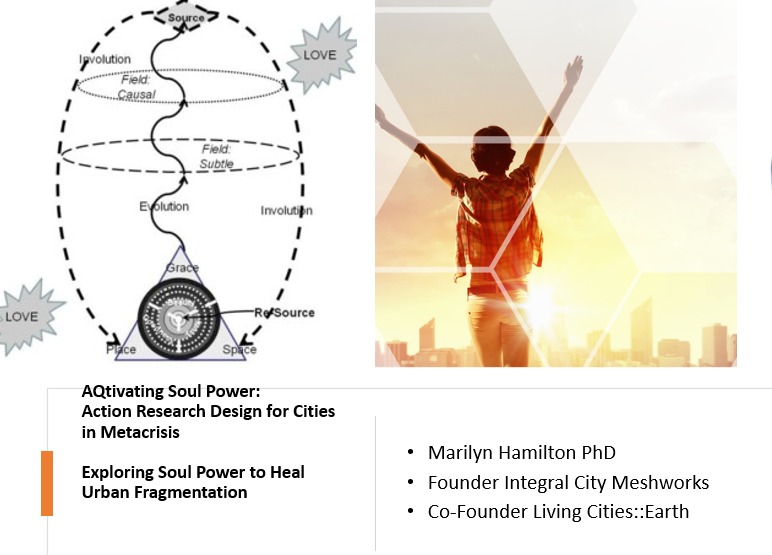
What If Our Cities Have Become Disconnected from Their Souls?
Look around our cities today.
We see extraordinary concentrations of human creativity, intelligence, culture and possibility. Yet we also see fragmentation, war, climate disruption, pollution, biodiversity loss, deteriorating infrastructure, housing insecurity and economies that too often diminish the very life they are intended to support.
We have become remarkably skilled at building cities. But have we become equally skilled at caring for the life within them?
Perhaps the Metacrisis confronting our cities is not simply a collection of separate environmental, political, economic and social crises.
Perhaps these crises are symptoms of a deeper disconnection — from one another, from Nature, from the living systems that sustain us, and ultimately from our own Soul.
This was the inquiry I brought to the California Institute of Integral Studies Blue Sky Leaders programme in July 2026.
I called it AQtivating Soul Power: Action Research Design for Cities in Metacrisis.
The unusual spelling of AQtivating is intentional. It invites us to activate our capacities for action through the Integral AQAL perspective — recognising that our individual interiors, collective cultures, observable behaviours and shared systems all participate in shaping reality.
My invitation was to explore whether reconnecting with Beauty, Truth and Goodness might help us discover new ways to heal our cities.
Rather than beginning with answers, we began with three questions familiar to Action Research:
What? So What? Now What?
WHAT? Recognising the Metacrisis
What is broken in our cities?
At first glance, the answers seem painfully obvious.
Cities are threatened by climate change, damaged by warfare, burdened by pollution, fragmented by inequality and increasingly disconnected from the ecosystems that sustain them.
The work of the Intergovernmental Panel on Climate Change (IPCC) and the Intergovernmental Science-Policy Platform on Biodiversity and Ecosystem Services (IPBES) reveals the scale of the environmental challenges confronting humanity.
But these are not merely technical problems awaiting technical solutions.
When cities are bombed, flooded, overheated or deprived of functioning infrastructure, the consequences extend far beyond buildings and roads.
Homes, hospitals, schools, food systems, relationships, cultural memory and ecological habitats are damaged together.
The living fabric of the city is torn.
Drawing on my Integral City research, I have come to understand cities as complex adaptive living systems — Human Hives.
Like beehives, cities depend on the coordinated intelligences of many participants. Their health arises from relationships, exchanges, contributions and capacities distributed throughout the whole.
When those relationships become fragmented, the Human Hive loses its ability to respond intelligently to changing conditions.
We might therefore ask a deeper question:
What happens when our cities cease to recognise themselves as living systems?
And what happens when humanity forgets that our cities are embedded within the larger living body of Gaia?
SO WHAT? The Consequences of Disconnection
The Metacrisis matters because the damage is not confined to any one scale.
When we damage people, we damage communities.
When we damage communities, we damage places.
When we damage places and their ecosystems, we threaten the planetary conditions upon which all life depends.
The consequences ripple across the nested systems of Person, People, Place and Planet.
Our cities depend on the regenerative capacities of Nature — from microbes and mycelial networks to pollinators, forests, watersheds, oceans and the atmosphere.
Yet our dominant patterns of extraction, competition, conflict and consumption frequently undermine those very capacities.
In this sense, the Metacrisis may be understood as a crisis of relationship.
Have We Lost Connection with Soul?
Several thinkers have helped me explore this possibility.
Nish Dubashia invites reflection on our disconnection from the toroidal flows of life.
Karen O’Brien, in You Matter More Than You Think, explores the significance of fractals, wholeness and entanglement, reminding us that individual and collective actions can influence wider patterns of change.
Jude Currivan, in A Radical View of Reality, proposes a worldview in which consciousness is primary and the universe is fundamentally interconnected.
Said Dawlabani’s Second Sapiens explores the possibility of an emerging planetary mind.
And Iain McGilchrist’s work invites us to question whether our dominant ways of perceiving and organising reality have separated us from the living wholeness of existence.
These perspectives do not offer identical explanations. But together they challenge us to reconsider the assumptions through which we understand ourselves, our cities and our world.
What if the deeper problem is not simply that our systems are failing?
What if we have lost touch with the Beauty, Truth and Goodness that can orient those systems towards life?
Beauty, Truth and Goodness as Living Capacities
In Integral perspectives, Beauty, Truth and Goodness are more than abstract ideals.
They invite us to engage different dimensions of reality.
Beauty opens us to the lived experience of aliveness — the felt qualities of connection, wonder, meaning and participation in the living world.
Truth asks us to see reality more fully, drawing upon multiple ways of knowing, scientific evidence, lived experience and systems understanding.
Goodness calls us into ethical relationship — caring, justice, compassion, cooperation and responsibility for the wellbeing of the whole.
When these dimensions are separated, we risk fragmented responses to fragmented problems.
When they are brought into relationship, we may discover capacities for healing that were previously invisible.
This is what I mean by exploring Soul Power.
Not power over others, but the capacity to reconnect with the deeper sources of aliveness, coherence and care.
NOW WHAT? Designing Action Research for Healing
If disconnection contributes to the Metacrisis, how might reconnection become a practical pathway towards regeneration?
This is where Action Research becomes essential.
We cannot simply declare that cities need Soul Power.
We must explore what practices might cultivate it, how they affect people and places, and what we can learn from the results.
In my CIIS workshop, I invited participants to consider how we might design healing journeys that reconnect our cities with Beauty, Truth and Goodness.
Drawing from Integral City, Living Cities, biomimicry, developmental perspectives, peacebuilding and ecovillage experience, I proposed ten capacities that could help guide such research.
Continued in Part 2 here.
This Part 1 of 2 part Blog.
Marilyn Hamilton, PhD, is Founder of Integral City Meshworks, Co-Founder of Living Cities.Earth and Chair of Findhorn Foundation SCIO. Her Integral City research explores the intelligences and practices that support resilient, regenerative and life-serving Human Hives.
Adapted from “AQtivating Soul Power: Action Research Design for Cities in Metacrisis,” presented at the California Institute of Integral Studies Blue Sky Leaders residency, July 2026.

Leave A Comment