
This is Part 2 of the exploration of AQtivating Soul Power
By Marilyn Hamilton, PhD
Adapted from a lecture and Action Research workshop presented to the California Institute of Integral Studies (CIIS) Blue Sky Leaders programme, July 2026.
- Practise Gaia’s Master Code of Care
Begin with an ethic of caring for Self, Others, Place and Planet.
This is both a practice and a theory of change. Caring for ourselves can strengthen our capacity to care for others, expanding our circles of compassion into the communities and ecosystems that sustain us.
Safety and security are foundational to human flourishing.
Healing begins by restoring trust, reducing fear and creating conditions in which individuals, families, neighbourhoods and communities can recover their capacity for peaceful coexistence.
- Restore Peace and Heal Conflict
Draw upon the Four Voices of the City — Citizens, Civic Managers, Business/Innovators and the Third Sector — to develop community capacities for reconciliation.
Inspired by approaches such as William Ury’s Third Side and Thomas Hübl’s work with collective trauma, we can explore ways of addressing injury, injustice and conflict without perpetuating cycles of harm.
- Recognise Cities as Living Systems
Cities are not machines to be repaired by experts alone.
They are living systems with intelligences distributed across individuals, organisations, neighbourhoods, communities and bioregions.
Integral City’s GPS framework helps us recognise and coordinate these capacities for survival, adaptation and regeneration.
- Learn from Nature Through Biomimicry
Nature has been experimenting with resilience and regeneration for billions of years.
Beehives, forests, ecosystems and other living collectives offer lessons in cooperation, distributed intelligence, adaptation and renewal.
What might our Human Hives learn from these patterns?
- Embrace Four Dimensions of Reality
Integral perspectives remind us that intentions, cultures, behaviours and systems co-arise.
Lasting regeneration requires attention to all four.
Changing infrastructure without changing culture may be insufficient. Changing individual behaviour without addressing systemic conditions may be equally limited.
- Empower Four Ways of Knowing
We need subjective, intersubjective, objective and interobjective perspectives.
Personal experience, shared meaning, empirical evidence and systems understanding each contribute essential knowledge.
By bringing these perspectives into dialogue, we can design more inclusive and effective responses.
- Activate the Four Voices for Unity
Citizens, Civic Managers, Business/Innovators and the Third Sector each bring distinct intelligences and resources.
When these voices work together in service of the whole, they strengthen the city’s capacity for coordinated action, recovery and peace.
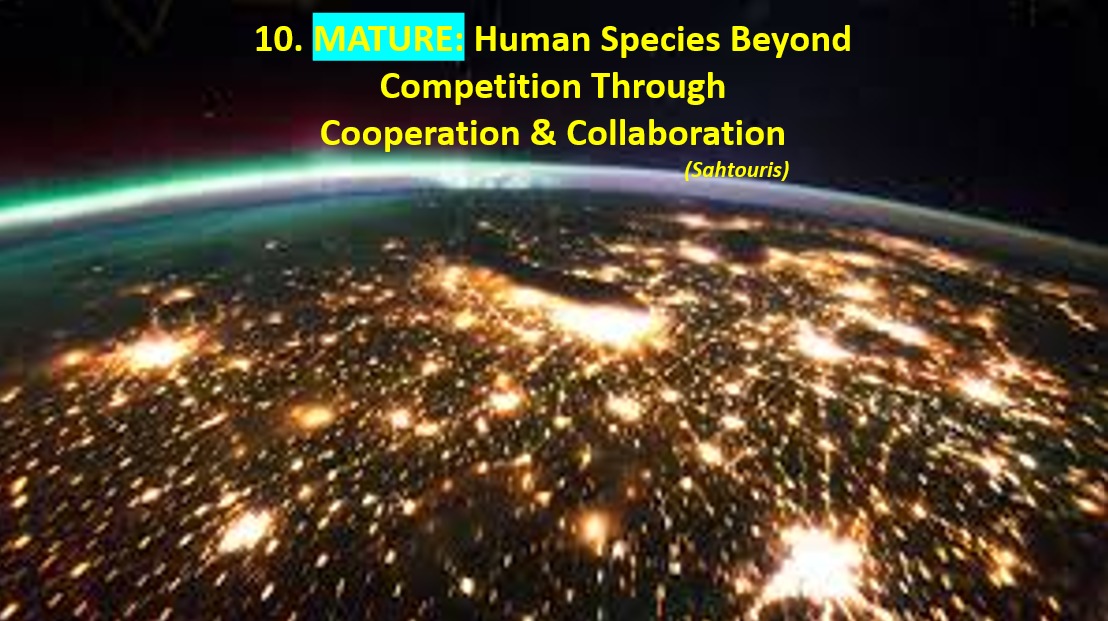
- Mature Beyond Competition Towards Collaboration
Evolutionary perspectives, including the work of Elisabet Sahtouris, invite us to recognise the possibilities of cooperation and collaboration.
Our challenge is to create life conditions that encourage mutual contribution rather than destructive competition.
- Regrow Cities Through Developmental Stages
Regeneration is not an instantaneous event.
It unfolds through steps and stages appropriate to the capacities and circumstances of each place.
Cities can learn to recover, integrate and expand their capacities for Unity and Peace — while supporting one another across their bioregions.
Together, these ten capacities offer a starting framework for researching how cities might move from fragmentation towards greater coherence and aliveness.
From Ideas to Experiments: How Would We Know?
An Action Research approach asks us to move beyond inspiration into inquiry.
Imagine a neighbourhood experiencing fragmentation, ecological decline and mistrust.
What if its residents, civic leaders, businesses and community organisations began by practising Gaia’s Master Code of Care?
What if they created spaces for deep listening, restored neglected natural places and experimented with new forms of cooperation?
We could then ask:
- What changes in people’s experience of belonging, trust and wellbeing?
- What happens to cooperation among the Four Voices?
- Do ecological conditions improve?
- What new capacities emerge for resolving conflict and making collective decisions?
- Which practices seem most effective, for whom, and under what conditions?
The research would not assume that Soul Power had solved the problem.
It would investigate whether practices grounded in Beauty, Truth and Goodness contribute to measurable and experienced changes in the life of the community.
We would learn through cycles of action, observation, reflection and adaptation.
In this way, Soul Power becomes not merely a philosophical possibility, but an invitation to practical, participatory inquiry.
Integral Soul Practices: Beginning Where We Are
Some of the most promising experiments need not begin at the scale of an entire city.
They can begin with individuals and small groups.
Gaia’s Code of Care offers a daily practice of extending compassion.
The invitation to Wake Up, Grow Up, Show Up, Clean Up, Lift Up, Link Up and Whole Up encourages us to develop our capacities for conscious participation and collective change.
Ecovillages — rural, urban and mixed — offer living laboratories for experimenting with regenerative relationships.
And Nature offers remarkable models of collective intelligence.
Consider a murmuration of birds.
Each bird responds to its neighbours while participating in a larger, constantly changing pattern.
No single bird controls the whole formation.
Yet together they create a coherent, adaptive movement.
Might our cities learn to self-organise with similar sensitivity?
We can also cultivate Islands of Calm and Islands of Coherence — spaces where people practise presence, deep listening and mutual care, strengthening their capacity to respond constructively to uncertainty.
Such practices may appear small compared with the scale of the Metacrisis.
But complex living systems remind us that change can emerge through interactions across many scales.
Park Ecovillage Findhorn: A Living Inquiry into Soul
My own home at Park Ecovillage Findhorn in Scotland offers an ongoing opportunity to explore these questions.
Findhorn is more than an ecovillage.
It is a community with a long history of spiritual practice, ecological experimentation, education and co-creation with the Intelligences of Nature.
It is also a community navigating profound organisational and social change.
Our experience reminds me that being hospitable to Soul does not mean escaping difficulty.
It means cultivating the capacities to remain present, caring and creative within it.
Through deep inner listening, community practice, regenerative education and evolving forms of stewardship, we continue exploring what it means to serve life.
I describe this aspiration as becoming a community hospitable to the Soul — for Planet, Place, People and Person.
We are not a finished model.
We are a living experiment.
And perhaps that is precisely what our cities need: more places willing to experiment consciously with the conditions for regeneration.
AQtivating Soul Power: An Invitation to Re-Story Aliveness
James Lovelock‘s Gaia perspective invites us to imagine humanity as part of Earth’s capacity for reflection and self-awareness.
What if we understood ourselves as Gaia’s reflective organs?
What if our cities became places where humanity could consciously participate in the regeneration of the living planet?
Such questions invite us to move beyond the assumption that the Metacrisis can be resolved solely through technological innovation, economic restructuring or institutional reform.
All these may be necessary.
But they may not be sufficient without a corresponding transformation in consciousness, culture, relationships and care.
This is the deeper possibility I wanted to explore with the CIIS Blue Sky Leaders.
What? Our cities are experiencing interconnected crises that threaten the conditions for life.
So What? These crises may reveal a profound disconnection from the living wholeness of which we are part.
Now What? We can begin designing and testing practices that reconnect Beauty, Truth and Goodness with the everyday realities of our Human Hives.
Perhaps the most important research question is not simply:
How do we fix our broken cities?
But rather:
How might we AQtivate Soul Power so that our cities become places where life can flourish again?
This is an invitation to researchers, practitioners, civic leaders, communities and regenerators everywhere.
To bring our whole selves to the Metacrisis.
To practise caring as a regenerative capacity.
To experiment with new forms of cooperation.
To listen deeply to the intelligences of Nature.
And to participate consciously in Re-Storying Aliveness for the Human Hive.
For the future of our cities may depend not only on what we build, but on what we remember about who we are — and how we belong to life.
Marilyn Hamilton, PhD, is Founder of Integral City Meshworks, Co-Founder of Living Cities.Earth and Chair of Findhorn Foundation SCIO. Her Integral City research explores the intelligences and practices that support resilient, regenerative and life-serving Human Hives.
Adapted from “AQtivating Soul Power: Action Research Design for Cities in Metacrisis,” presented at the California Institute of Integral Studies Blue Sky Leaders residency, July 2026.

Leave A Comment