
What enables a community to survive profound disruption without losing its soul?
Over the last eight years I have found myself living inside that question.
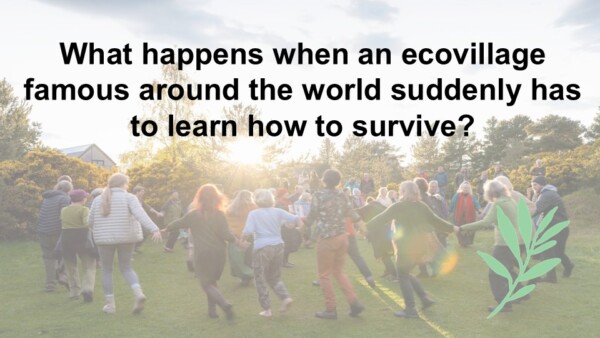
When I arrived in Park Ecovillage Findhorn, I did not expect to become immersed in the politics of organizational transition. My work had long focused on Integral City, Living Cities Earth, and understanding how human hives learn, adapt, and evolve. Yet the unfolding story of Findhorn invited me into a different kind of inquiry.
During these years I have witnessed the decline of the original Findhorn Foundation, the creation of a first SCIO, and now the co-creation of a second SCIO with an emerging two-tier constitution. Along the way came financial pressures, leadership transitions, fires, asset transfers, governance redesign, community tensions, and the ever-present challenge of maintaining trust while navigating uncertainty.
Like many communities around the world, Findhorn found itself living inside a VUCA storm—an environment characterized by volatility, uncertainty, complexity, and ambiguity.
The question was no longer:
“How do we create a better future?”
The question became:
“Can this community survive while remaining true to its soul?”
When Politics Became Personal
At first, I assumed the central challenge would be political in the conventional sense. I expected debates about governance, authority, constitutions, and decision-making.
Instead, I discovered something quite different.
The deepest political questions were often about:
- Belonging
- Grief
- Identity
- Trust
- Meaning
- Stewardship
What surprised me most was that the politics was rarely about power alone.
It was about maintaining coherence in the midst of change.
The Human Hive Lens
As I reflected on what was happening, I began to see recurring patterns through the lens of Integral City and the Human Hive.
Again and again, four forms of stewardship intelligence appeared.
Carers
The Carers held the hive together.
They maintained relationships, tended conflict, cared for elders, listened deeply, and protected social coherence.
Their lesson: Survival begins with trust.
Curators
The Curators preserved meaning.
They asked what was essential, what should be carried forward, and what could be released.
They stewarded values, stories, practices, and the educational impulse.
Their lesson: Regeneration requires memory.
Choreographers
The Choreographers re-wove relationships.
They convened conversations, built bridges between organizations, redesigned governance, and nurtured collaboration.
Their lesson: The future emerges through relationships, not control.
Changemakers
The Changemakers created new possibilities.
They experimented with new programmes, partnerships, structures, and forms.
Their lesson: Evolution requires experimentation.
A New Political Question
One realization gradually changed my understanding of politics.
The question was not:
“Who is in charge?”
The question became:
“Which intelligence is needed now?”
At different moments, different intelligences needed to lead.
- Sometimes trust required Carers.
- Sometimes continuity required Curators.
- Sometimes complexity required Choreographers.
- Sometimes emergence required Changemakers.
The health of the whole depended upon the appropriate intelligence stepping forward at the right time.
Politics as the Search for Coherence
In recent conversations with colleagues at the Institute for Integral Studies in Freiburg (IFIS), I encountered a phrase that deeply resonated with my experience.
Politics can be understood as: The search for coherence.
This framing immediately connected with Integral City’s GPS framework.
If politics is the search for coherence, then Integral City invites a complementary question:
What intelligences enable coherence to emerge?
That question may become increasingly important as communities, organizations, cities, and societies face accelerating uncertainty.
From Survival to Soul
Today I find myself viewing Integral Politics somewhat differently than when I began.
Integral Politics is not merely the management of competing interests.
It is the stewardship of a living field of relationships that enables collective evolution.
And perhaps the deepest political question of all is not:
“Who decides?”
Nor even:
“Which intelligence is needed now?”
But:
“What is life asking of us now?”
That question points toward a deeper practice of attunement—one that Findhorn has explored for more than six decades through inner listening, co-creation with the Intelligences of Nature, and service to the wellbeing of the whole.
As we approach the Solstice, I invite us to consider:
What forms of intelligence enable communities not merely to survive—but to evolve?
This question will guide the next series of reflections exploring the Layers of Intelligence that support human hives, organizations, cities, and communities in times of transformation.
This is an index for this Blog series.
From Survival to Soul: A Journey through the Intelligences of the Human Hive
-
From Survival to Soul: Discovering the Intelligences of Integral Politics
-
Functional Intelligences of the Human Hive: How Life Organizes Itself
-
Stewarding Intelligences: How Life Cares for Itself
-
Attuning Intelligences: How Gaia Listens Through Us
-
Collective Intelligence: How Gaia Learns Through Us
-
Agency Intelligence: How Gaia Chooses Through Us
-
Layers of Intelligence: Towards an Integral Politics of Coherence

Leave A Comment