
“The city is not merely a collection of people. It is a living system learning
how to become conscious of itself.”
In the first article of this series, I suggested that the journey of our time is a movement from Survival to Soul. Yet soul does not emerge through aspiration alone. It emerges when life organizes itself in ways that support wholeness.
Nature offers countless examples of this wisdom. Among the most fascinating is the honey bee hive. A hive survives, adapts, and thrives not because every bee does the same thing, but because different bees contribute different functions in service of the whole. The intelligence of the hive emerges through the internal goal the beehive sets (to produce 20kg of honey per year), its capacity to communicate about the eco-region in which it lives and the relationship between the functions that serve the internal goal. What’s more the beehive also serves an external goal – which is to pollinate the plants in the surrounding area so that they produce the renewable energy that the bees need for next year (thus creating a cycle of regeneration).
Over the years, I have surmised that the same is true for human communities, organizations, and cities.
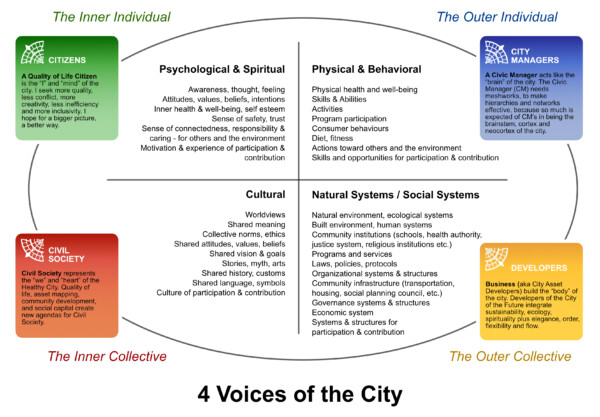
Since I started exploring the city as a Human Hive, I discovered that healthy cities express four essential Voices. Each voice contributes a distinct intelligence to the life of the whole. Together they create the conditions for resilience, regeneration, and emergence. (Integral City)
Citizens bring the intelligence of lived experience. They are the “I” of the city — sensing needs, aspirations, creativity, and possibility.
Civil Society brings the intelligence of relationship and belonging. It is the “We” of the city — cultivating trust, culture, care, and social cohesion.
Civic Managers bring the intelligence of coordination and governance. They steward the “its” of the city – structures, policies, and systems that enable collective action.
Business and Enterprise develop the intelligence of value creation. This is the “They” who mobilize resources, innovate, and develop productive capacity to meet human needs.
These four Voices are not sectors competing for influence. They are complementary functions in a living system. Each becomes stronger when it serves the others and altogether, they are serving a common goal.
The bees reveal a similar pattern.
Within the hive we find Forager-Producers, Diversity Generators, Resource Allocators, Integrators, and. Up to 90% gather resources (nectar and pollen). About 5 % explore entirely new possibilities that may become essential for the future. A small group reward productive effort. And the Hive Mind monitors the wellbeing of the whole. Together they create a dynamic ecology of intelligence that enables adaptation and resilience. (Integral City)
Human systems require the same diversity of function.
When only production matters, innovation dries up.
When only governance matters, vitality declines.
When only community matters, resources become scarce.
When only individual voices dominate, coherence fragments.
Life flourishes when all functions are present and in relationship.
This insight has profound implications for politics. Rather than asking, “Who should have power?” we might ask, “Which intelligences are needed now?” Rather than organizing around competing interests, we can learn to organize around complementary functions and shared goals.
The challenge of our century may not be a lack of intelligence. It may be our failure to recognize the many forms intelligence already takes.
The Human Hive invites us to see cities, communities, and organizations as living systems where multiple intelligences collaborate in service of life. When we learn to value each function, listen to each voice, and cultivate the relationships between them, something remarkable becomes possible.
The whole becomes wiser than any of its parts.
And that may be where the soul of the city begins to speak.
If the Functional Intelligences tell us what the Human Hive does, the Stewardship Intelligences reveal who stewards these functions on behalf of the whole. In the next article we explore the four stewardship roles of Carers, Curators, Choreographers, and Changemakers.
This is an index for this Blog series.
From Survival to Soul: A Journey through the Intelligences of the Human Hive
-
From Survival to Soul: Discovering the Intelligences of Integral Politics
-
Functional Intelligences of the Human Hive: How Life Organizes Itself
-
Stewarding Intelligences: How Life Cares for Itself
-
Attuning Intelligences: How Gaia Listens Through Us
-
Collective Intelligence: How Gaia Learns Through Us
-
Agency Intelligence: How Gaia Chooses Through Us
-
Layers of Intelligence: Towards an Integral Politics of Coherence

Leave A Comment